
A Guide to Surviving a Broken Democracy
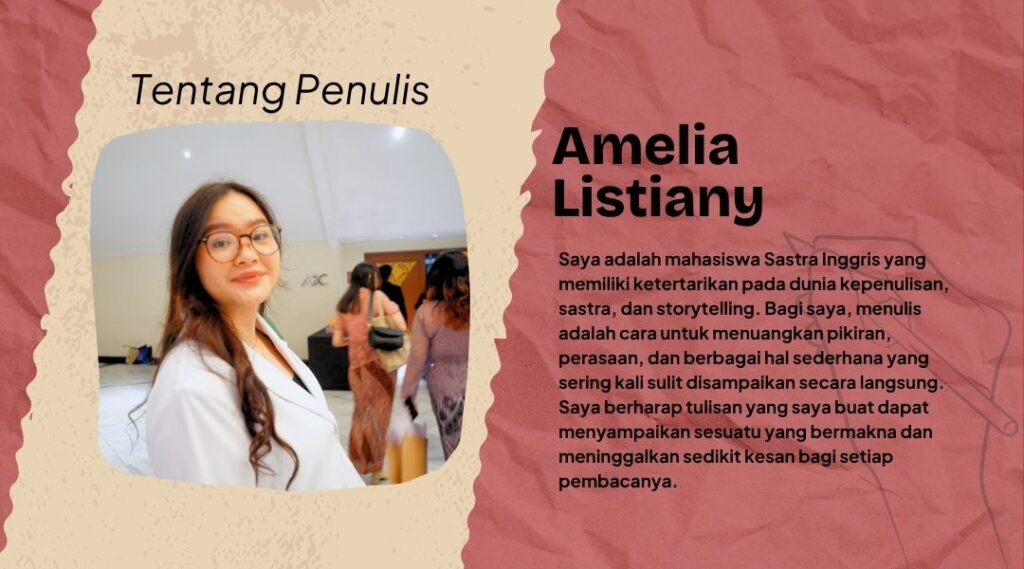
Penulis: Amelia Listiany – Universitas Kristen Indonesia
They told us democracy meant freedom, that our voices mattered, and that the future belonged to us. But what happens when the people elected to protect that future become the very reason we have to fight for it?
Between broken promises, corruption scandals, political propaganda, and a generation constantly told to stay out of politics, one question remains: how do you save a country that refuses to listen?
Perhaps it starts with those who refuse to stay silent.
Chapter One: The Country Is Doing Just Fine
According to the government, everything was going perfectly.
The economy was growing. The people were prospering. Corruption was being handled. The forests were being protected. And, apparently, the country had never been in better hands.
At least, that was what the television said.
On the other hand, Alyssa had just spent twenty minutes trying to find a news article about another corruption scandal before her internet connection disappeared. Her mother was complaining about the rising price of groceries, her father was watching another government press conference, and someone in the family WhatsApp group had just forwarded a message claiming that the country’s environmental crisis was nothing more than foreign propaganda.
It was a normal Tuesday.
“Do you think they actually believe what they’re saying?” Alyssa asked.
Across the cafeteria table, Zack looked up from his phone.
“Who?”
“The government.”
Zack laughed. “I think believing it is part of the job description.”
Alyssa rolled her eyes.
She was a twenty-year-old university student majoring in journalism. She had always been interested in writing, but politics was something she preferred to observe from a distance. It was exhausting, unpredictable, and seemed to turn perfectly reasonable people into strangers arguing in comment sections.
Until recently, she had convinced herself that staying out of it was the easiest way to stay sane.
Then came the news about the forests.
Several villages in a rural district had been affected by severe flooding following extensive land clearing. Families had lost their homes, agricultural land had been damaged, and environmental organizations were questioning the permits granted to several companies operating in the area.
The government’s response?
A beautifully edited video titled Our Commitment to a Greener Indonesia.
It featured smiling officials planting trees, children holding miniature flags, and a narrator speaking about the importance of environmental sustainability.
The video received thousands of likes.
The villagers received almost nothing.
“Someone should probably tell them that planting ten trees for a camera doesn’t replace an entire forest,” said Dimas, dropping into the empty chair beside Alyssa.
“Careful,” Zack replied. “You might get accused of spreading negativity.”
“Right. Sorry. The forest is thriving. The villagers are simply experiencing an alternative form of tourism.”
They laughed, although nobody found it particularly funny.
At the end of the table, Alya was scrolling through the latest news.
“Guys, look at this.”
She turned her phone around.
A government spokesperson had publicly dismissed the criticism as politically motivated misinformation. According to the statement, the situation was under control, and citizens were encouraged to avoid sharing unverified information.
Beneath the statement was a comment from someone claiming to be a resident of the affected village.
If everything is under control, why are we still waiting for help?
For a moment, nobody spoke.
Then Alyssa closed her laptop.
“I think we should do something.”
Dimas raised an eyebrow.
“Like what? Become ministers?”
“God forbid,” Alya replied.
“No,” Alyssa said. “I mean actually do something. Write about it. Talk about it. Make people pay attention.”
Zack leaned back in his chair.
“And what happens when nobody listens?”
Alyssa looked at him.
“Then we make it harder for them to ignore us.”
Chapter Two: The Comment Section Is a Battlefield
Their first meeting took place in a small coffee shop near campus.
There were five of them: Alyssa, Zack, Alya, Dimas, and Farhan.
They had different academic backgrounds, different family circumstances, and, occasionally, different political opinions. But they shared one particular frustration: the growing distance between what their country promised and what its people actually experienced.
Farhan, a law student, was particularly interested in government accountability.
Alya, who studied communications, was fascinated by how political narratives spread through social media.
Dimas was the group’s resident comedian, although his jokes were usually just observations about things nobody wanted to admit.
And Zack?
Zack studied political science. He was the kind of person who could turn a five-minute conversation about coffee prices into a forty-minute discussion about public policy.
Alyssa found it both impressive and slightly annoying.
They decided to start a small online platform where they would publish articles, infographics, and short videos explaining political issues in language that young people could understand.
They called it The People’s Desk.
Their first post was about environmental destruction and government accountability.
The second discussed corruption and the importance of independent journalism.
The third was a simple infographic explaining the difference between criticism and misinformation.
It was the third post that attracted the most attention.
Unfortunately, not all of it was positive.
Another group of unemployed students pretending to be experts.
“Why don’t you focus on studying instead of criticizing the government?”
“Everything is political with these people.”
One comment particularly caught Alyssa’s attention.
“If you don’t like this country, just leave.”
She stared at the screen.
“Interesting,” she said. “Apparently, loving your country means never questioning it.”
Zack glanced over her shoulder.
“That’s the problem with political loyalty. Some people confuse supporting a leader with supporting the country.”
“Are you saying they’re the same thing?”
“No. I’m saying they shouldn’t be.”
Alyssa turned toward him.
“That’s surprisingly sensible.”
“I have my moments.”
“Rarely.”
He smiled.
And for a second, politics was the last thing on her mind.
Chapter Three: A Very Convenient Truth
Things became more complicated when The People’s Desk published an article questioning the government’s environmental protection campaign.
They had spent days researching the issue, comparing official statements with independent reports, and interviewing people familiar with the situation.
Their conclusion was simple: the public deserved transparency.
They didn’t accuse anyone without evidence. They didn’t make dramatic claims. They simply asked questions.
But apparently, asking questions was enough to make people uncomfortable.
A popular account with a large following shared a screenshot of their article, accusing them of spreading propaganda.
Within hours, their comment section was flooded.
Someone claimed they were being funded by foreign organizations. Another accused them of trying to destroy national unity. A third posted an edited picture of Alyssa with the words Professional Government Hater.
Dimas found it hilarious.
“I’ve finally become famous,” he announced. “My mother is going to be so proud.”
Nobody else was laughing.
Alya was worried about the misinformation spreading beyond their original audience. Farhan suggested publishing their sources and clarifying their findings.
Zack, however, was unusually quiet.
“What’s wrong?” Alyssa asked him.
“Nothing.”
“You’re terrible at lying.”
He put his phone down.
“My father thinks what we’re doing is dangerous.”
Alyssa waited.
“He believes the government deserves a chance. He thinks criticism like ours creates instability.”
“Does he think the problems aren’t real?”
“He thinks we’re focusing too much on the negative.”
Alyssa sighed.
“I don’t think wanting accountability means hating your country.”
“I know.”
“Then what’s the problem?”
Zack looked at her.
“Sometimes, it’s difficult when the people you love see things differently.”
For the first time, Alyssa understood that political disagreements weren’t always about statistics, policies, or election results.
Sometimes, they happened around dinner tables.
Sometimes, they lived inside families.
And sometimes, they made people question whether standing up for something was worth disappointing someone they cared about.
Chapter Four: The Art of Staying Silent
A few weeks later, the university announced a public discussion about democracy, freedom of speech, and the responsibility of young citizens.
The People’s Desk decided to participate.
They invited several student organizations, independent journalists, and representatives from environmental communities.
The discussion was supposed to be an opportunity for different perspectives.
Instead, it became a reminder of how uncomfortable disagreement could make people.
One speaker argued that young people should stop criticizing the government without understanding the difficulties of running a country.
Another insisted that democracy required citizens to question those in power, regardless of political affiliation.
A third spent most of his time defending a politician who wasn’t even present.
Dimas leaned toward Alyssa.
“Imagine defending someone who doesn’t know you exist.”
She almost laughed.
But then something changed.
A student from another faculty stood up and spoke about his hometown. He explained how his community had struggled with environmental damage and how official promises had repeatedly failed to bring meaningful improvements.
He wasn’t particularly eloquent. He didn’t use complicated political terminology.
He simply wanted someone to listen.
Alyssa watched the room.
Some people looked uncomfortable. Others checked their phones. A few nodded.
And she realized that political awareness wasn’t always about knowing every political theory or memorizing every government regulation.
Sometimes, it started with listening to someone whose problems had been ignored.
After the discussion, Zack found her standing outside the auditorium.
“You were quiet in there.”
“I was thinking.”
“About?”
“How strange it is that people can spend hours arguing about which politician is right without ever asking whether the people they’re supposed to represent are actually doing okay.”
Zack nodded.
“That’s politics for you.”
“No. That’s what happens when politics becomes more about winning than serving.”
He looked at her for a moment.
“You should write that down.”
“Maybe I will.”
Chapter Five: Democracy Is Not a Spectator Sport
The following month, The People’s Desk organized a peaceful campus gathering.
It wasn’t a particularly large event. There were no famous speakers or expensive banners. Just students, handwritten posters, and a microphone that occasionally stopped working.
Their message was straightforward:
Accountability is not an attack.
Criticism is not betrayal.
Democracy requires participation.
They discussed environmental protection, corruption, freedom of speech, and the importance of independent institutions.
Some students shared personal experiences. Others asked questions they had previously been afraid to ask.
Not everyone agreed with them.
And that was fine.
In fact, Alyssa thought disagreement was one of the most important things they needed to protect.
Democracy was never supposed to be a room where everyone repeated the same opinion. It was supposed to be a place where different voices could exist without being treated as enemies.
As the event continued, Alyssa noticed a familiar face standing near the entrance.
It was a student who had previously criticized their online platform.
He approached her after the discussion.
“I still disagree with some of your opinions,” he said.
Alyssa nodded.
“That’s okay.”
“But I think I understand what you’re trying to do.”
She smiled.
“That’s a start.”
Later that evening, the group sat together on the university steps.
Their clothes smelled like dust, their voices were tired, and Dimas had somehow managed to lose the event’s remaining budget receipt.
“Well,” he announced, “we have officially changed the country.”
Alya laughed.
“We organized one campus discussion.”
“Exactly. Give it a few business days.”
Farhan shook his head.
Alyssa looked at them, feeling strangely grateful.
They weren’t politicians. They weren’t influential public figures. They didn’t have the power to change national policies overnight.
They were simply students who had decided that being young wasn’t a good enough excuse to remain uninformed.
And perhaps that was where everything began.
Chapter Six: A Guide to Surviving a Broken Democracy
A few days later, Alyssa sat in front of her laptop, trying to write an article about everything that had happened.
She opened a blank document.
For several minutes, she stared at the screen.
Then she began typing.
She wrote about a country where political promises were often louder than political accountability. About people who defended leaders more passionately than they defended the values those leaders were supposed to represent. About forests disappearing while official campaigns celebrated sustainability.
She wrote about misinformation, manipulated narratives, and the strange ability of social media to turn political disagreements into personal hatred.
But most importantly, she wrote about young people.
People who were constantly told they were too young to understand politics, yet were old enough to experience the consequences of political decisions.
People who were expected to inherit the future but rarely invited to question the present.
She stopped for a moment and looked at the title.
A Guide to Surviving a Broken Democracy.
It sounded dramatic.
Perhaps it was.
But she thought about the villagers waiting for help, the journalists trying to report the truth, the students who had spoken at their discussion, and all the ordinary people whose lives were affected by decisions made in rooms they would never enter.
Maybe democracy wasn’t something that could simply be declared healthy because an election had taken place.
Maybe it required more than voting every few years and hoping for the best.
It required citizens who questioned, journalists who investigated, institutions that remained accountable, and young people who refused to believe that silence was the same as peace.
Her phone vibrated.
A message from Zack appeared.
Zack: Finished writing?
Alyssa: Almost.
Zack: Is it good?
Alyssa: Depends. Do you think democracy can be saved?
There was a short pause.
Zack: I think it can be protected. But not by people who only care when their side wins.
Alyssa smiled at the screen.
Alyssa: That’s actually a good line.
Zack: I know. You can quote me.
She returned to her document.
Outside her window, the city continued moving. Cars passed, advertisements illuminated the streets, and somewhere, another politician was probably delivering another speech about a brighter future.
Tomorrow, there would be another scandal.
Another promise.
And perhaps another reason to feel disappointed.
But there would also be people asking questions.
People checking facts before sharing information.
People refusing to mistake political loyalty for patriotism.
People who understood that loving a country did not mean agreeing with everything its leaders did.
Alyssa finally typed the last sentence.
Democracy does not disappear overnight. Sometimes, it simply weakens every time people decide that asking questions is no longer worth the trouble.
She read it twice before saving the document.
Then she closed her laptop.
The country wasn’t fixed. The government hadn’t suddenly become accountable. The forests hadn’t magically returned, and the problems they had spent weeks discussing were still there.
But perhaps surviving a broken democracy was never about pretending everything would be fine.
It was about refusing to let things become worse simply because everyone had grown accustomed to them.
And if there was one thing Alyssa had learned, it was this:
You don’t have to be a politician to care about politics. You just have to be a citizen who understands that the future belongs to the people who refuse to stop paying attention.
The rest was up to them.
Produk Rekomendasi Sunday


*****
Dapatkan informasi mengenai kesehatan mental, edukasi seksual, dan tips pelajar hanya di Majalah Sunday, teman curhat remaja Indonesia.
Ikutan berkarya di
Konten Lainnya
Terbaru
Terbaru
Dengerin Podcast
Penasaran? Yuk, tonton sekarang di YouTube!
Terpopuler
Terpopuler
Views: 0