
The Art of Controlling Public-Speaking Anxiety While Presenting
Penulis: Lois Costantine Daneswara – Universitas Kristen Indonesia
Sunners, have you ever stood in front of your classmates, looked at everyone, and suddenly forgotten what you wanted to say? Your heart starts beating faster, your hands feel shaky, and even the words you practiced seem to disappear. If this sounds familiar, you are not alone.
Many teenagers experience nervousness when they have to speak in front of other people. Nervousness is a recognized form of anxiety, and research has shown that it can affect young people, particularly when they are worried about being judged or making mistakes. Studies also suggest that public-speaking anxiety can be managed through approaches such as preparation, practice, and gradual exposure to speaking situations (Kahlon et al., 2019; De Jong et al., 2021).
The good news is that being nervous does not mean you are bad at presenting. The goal is not to become a person who never feels nervous. Instead, the goal is to learn how to control that public-speaking anxiety, so that you can continue communicating your ideas.
1. Understand Why You Feel Anxiety
Before learning how to control presentation anxiety, it is important to understand where it comes from.
Ask yourself: What am I actually afraid of?
Are you afraid that you might stumble over your words? Are you worried that your classmates will judge you? Are you experiencing stage fright? Are you afraid of forgetting your material? Or perhaps you are simply confused about how to interact with your audience?
Understanding the reason behind your nervousness can help you deal with it more effectively. Research on adolescents has connected public-speaking anxiety with factors such as irrational beliefs and difficulties with emotional regulation (Demir & Kan, 2025).
Amanda C. Gorman provides an interesting real-life example. In her 2018 TED-Ed talk, she described being particularly afraid of speaking up because she had a speech impediment that made certain letters and sounds difficult to pronounce. She explained that although she felt comfortable expressing herself through writing, speaking on stage made her worry that her words might become jumbled or unclear (Gorman, 2018).
Her experience reminds us that presentation anxiety is not always about lacking knowledge or preparation. Sometimes, we are afraid because we are worried about how our words will sound when we say them in front of other people.
So, before saying, “I am just bad at presenting,” try asking yourself, “What exactly am I afraid will happen?”
Knowing the answer is the first step toward managing the fear.

2. Prepare Your Mind and Your Material
One of the best ways to reduce presentation anxiety is through preparation. However, preparation does not mean memorizing every sentence. Instead, use natural and simple language that feels comfortable to say. Spoken language is different from academic writing, so turning complicated sentences into words you would normally use can make your presentation easier to remember and more natural for the audience.
You also need to understand your material rather than memorize it word for word. Focus on the main ideas, important terms, examples, and conclusions. When you truly understand your topic, you can still explain it even if you forget a specific sentence. Think of your presentation as a journey: you do not need to memorize every step, as long as you know where you are going.
Finally, practice before the presentation. Start several days in advance by first understanding your material, then practicing how to explain it without constantly reading your script. You can practice in front of a mirror, record yourself, or present to a friend. Research also suggests that repeated practice and exposure can help young people manage public-speaking anxiety (Kahlon et al., 2019; De Jong et al., 2021). The more familiar you become with presenting, the less intimidating the experience may feel.

3. What to Do When Public-Speaking Anxiety Hits
Even after preparing and practicing, you may still feel the anxiety during your presentation. That is completely possible and it does not mean your preparation has failed.
So, what should you do when the anxiety suddenly hits?
Slow your breathing
When you become nervous, your body can enter a state of increased physiological arousal. One simple thing you can do is slow your breathing.
Zaccaro et al. (2018), in a systematic review of research on slow breathing, found evidence linking slow breathing with changes in physiological and psychological processes associated with stress and arousal.
When you notice yourself start to panic or feel anxiety, try slowing your breathing instead of rushing through your words. Take a comfortable breath in, then make your exhale slightly longer.
For example:
Inhale for about 3 seconds and exhale for about 5–6 seconds.
The purpose is not to take huge breaths. Instead, focus on making your breathing slower and more controlled.

Pause
If your mind suddenly goes blank, pause.
A pause is not a failure. You do not have to fill every second with words. Take a moment. Look at your slide. Breathe. Find the next keyword, and continue. Your audience may simply see it as a normal pause, while you may feel as though you have been silent for an eternity.

Slow down your first sentence
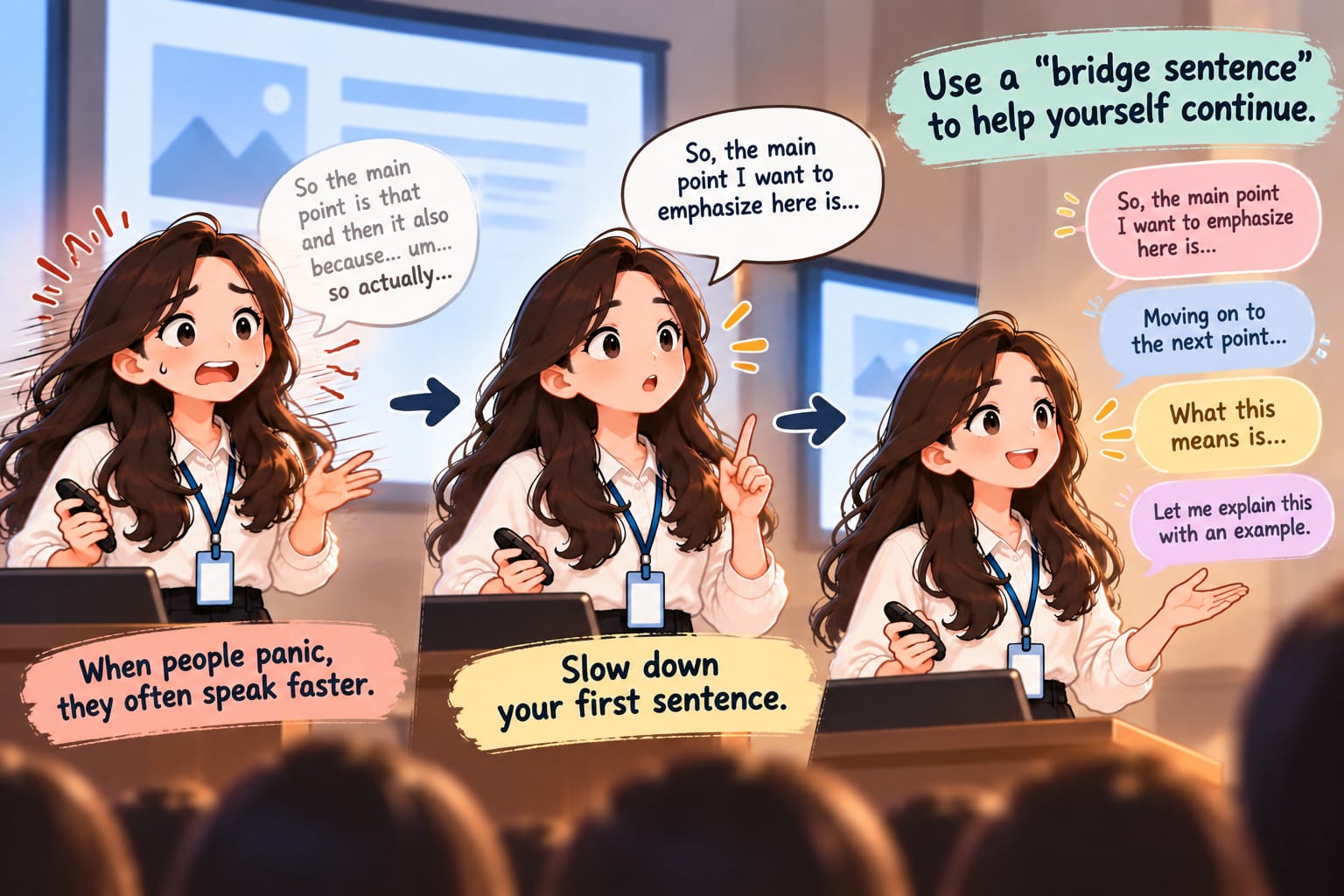
When people feel public-speaking anxiety or nervous, they often speak faster. Unfortunately, speaking faster can make it even harder to think clearly. So, when you begin speaking again, deliberately slow down your first sentence.
If you forget your point, use a “bridge sentence” to help yourself continue.
For example:
“So, the main point I want to emphasize here is…”
“Moving on to the next point…”
“What this means is…”
“Let me explain this with an example.”
These sentences can give you a moment to reconnect with your ideas while keeping the presentation moving. Most importantly, remember that you do not have to recover perfectly. You only have to continue.
Being anxiety during a presentation does not mean you are incapable of presenting. Confidence does not necessarily appear before you step onto the stage. Sometimes, confidence develops because you prepared, practiced, faced the fear, and continued even when you made mistakes.
You may stumble over a word. You may forget a sentence. Your hands may shake. Your voice may sound different from usual. And that is okay.
A successful presentation is not one in which nothing goes wrong. It is one in which you are still able to communicate your message despite the things that do go wrong.
So the next time you have to present in front of your classmates, remember three simple words: Prepare, breathe, speak.
*****
Produk Rekomendasi Sunday









Dapatkan informasi mengenai kesehatan mental, edukasi seksual, dan tips pelajar hanya di Majalah Sunday, teman curhat remaja Indonesia.
Ikutan berkarya di
2. Prepare Your Mind and Your Material
Konten Lainnya
Terbaru
Terbaru
Dengerin Podcast
Penasaran? Yuk, tonton sekarang di YouTube!
Terpopuler
Terpopuler
Post Views: 5